
The Line Item Nobody Itemizes
A website proposal usually arrives as one number. Ten thousand dollars, or twenty-five, or sixty. Underneath it there’s a scope — pages, features, a timeline — and a payment schedule. What almost never appears is the thing every other trade itemizes: how much of that number is labor on the actual product, and how much is everything else.
Ask a general contractor to bid a build-out and you get line items. Materials, subs, permits, supervision, margin. Ask a web agency and you get a total. That isn’t dishonest, exactly. But it does mean most business owners approve a website budget without ever seeing how much of it turns into a website.
So here’s the breakdown that doesn’t usually make it into the proposal.
Where a $10,000 Project Actually Lands
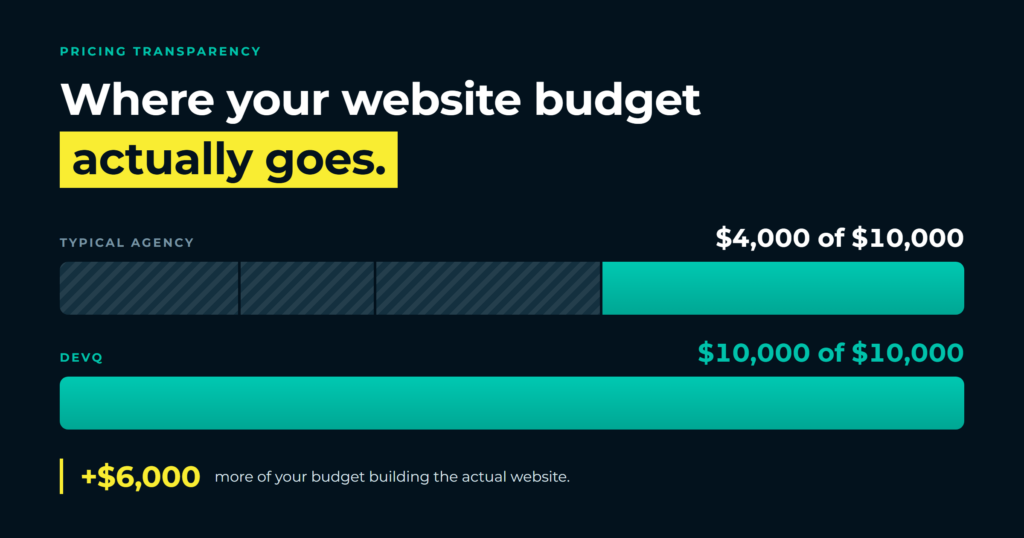
Run a ten thousand dollar site build through a typical mid-size agency and the money sorts itself into roughly four piles.
Account management — around 20%. Your day-to-day contact. They run the kickoff, take your feedback, write it up, pass it to the team, and come back with questions. They are usually good at their job and they are usually not the person building your site.
Sales and overhead — around 15%. The pitch that won your project, the proposal that took a week to write, the software licenses, the office, the time the team spent pitching the three clients who said no. Every business has this. It’s real cost, and it’s in your number.
Outsourced or junior development — around 25%. The person actually writing the code is frequently not the person who was in the room. Sometimes they’re junior staff, sometimes a subcontractor, sometimes an offshore shop with a markup on top. The agency bills you $150 an hour and pays $45.
The actual build — what’s left, around 40%. Design, front-end, back-end, content, QA. The part you thought you were buying.
Percentages vary by shop. The layers don’t. We put this on our home page as something you can move rather than read — set the slider to your own budget and watch where it lands.
Why Those Layers Exist
It would be easy to write the previous section as an accusation. It isn’t one.
An agency with twenty-five people genuinely needs account managers, because twenty-five people cannot all talk to every client. It needs a sales function, because a team that size has payroll to meet whether or not the phone rings. It subcontracts specialist work because keeping a full-time Shopify expert on staff makes no sense when you do four Shopify projects a year.
Those are rational answers to the problem of running a large company. The overhead is what it costs to be big, and being big buys you things — bench depth, continuity if someone quits, the capacity to run six projects at once.
The question isn’t whether the structure is justified. It’s whether you’re getting anything for it.
Where It Stops Being Worth It
The cost of the layers isn’t only financial. It’s the telephone game.
You describe a change to your account manager. They write it in a ticket. A project manager schedules it. A developer three time zones away reads the ticket and interprets it. What comes back is a reasonable interpretation of a written description of a thing you said out loud two weeks ago. Then you explain it again.
Every handoff is a place for intent to leak. On a big, complex build with a dozen stakeholders, that process is a feature — it creates a paper trail and keeps parallel workstreams from colliding. On a fifteen-page site for a business with one decision-maker, it’s pure friction, and you’re paying for it twice: once in the invoice, once in the calendar.
The tell is what happens to small changes. At a shop with the full structure, a twenty-minute CSS fix takes two weeks and costs three hundred dollars, because it has to be scoped, ticketed, assigned, scheduled, reviewed, and reported. Nobody is padding anything. The process just costs what it costs.
How to Read a Proposal
You can find most of this out before you sign, and none of these questions are rude. Any shop worth hiring answers them without flinching.
- Who writes the code? Not “our development team.” A person. Are they an employee, a contractor, or a subcontracted agency?
- Will that person be on any of our calls? If the answer is no, price in the translation loss.
- Who do I email when something breaks at 4pm on a Friday? Find out whether it’s a person or a queue, and what happens if that person is on vacation.
- What does a small change cost, start to finish? Ask for a real example from a current client — a copy tweak, a broken form. The answer tells you more about the shop than the whole proposal does.
- What percentage of this number is design and development labor? Some will tell you. The reaction to the question is informative on its own.
- If I leave, what do I take with me? Full export of files and database, no argument, no “proprietary platform.”
We wrote a longer version of this list a while back — twelve questions to ask before you hire a WordPress developer — and it’s worth running through even if you never call us.
What We Do Instead
DevQ is deliberately small. There is no account management layer, because the person who builds your site is the person you email. There’s no sales team, because the developer writes the proposal. Work that needs a specialist goes to a contractor we’ve used for years, managed directly, at cost we don’t mark up.
That structure has real limits, and it’s fair to name them. We can’t staff six simultaneous enterprise builds. If you need a 24/7 support desk with an SLA and three names on the escalation path, we are the wrong shop, and we’ll say so on the first call.
What it does mean is that a ten thousand dollar budget buys ten thousand dollars of building. The $150-an-hour rate and the person doing the work are the same rate and the same person.
The Test
You don’t need a proposal from us to find out where your current budget is going. Send your existing provider one email:
“Who specifically will be writing the code for this project, and will they be on our next call?”
A clear name and a yes means you’re paying for building. A vague answer about the team, or a redirect to your account manager, means you’re paying for coordination too — which may still be the right trade for you, but you should know you’re making it.
If you’d rather see it in numbers, the breakdown on our home page takes your actual budget and shows you both versions. And if you want a second opinion on a quote you’re holding, send it over. We’ll tell you what we’d charge and why, even if the answer is that you should stay where you are.